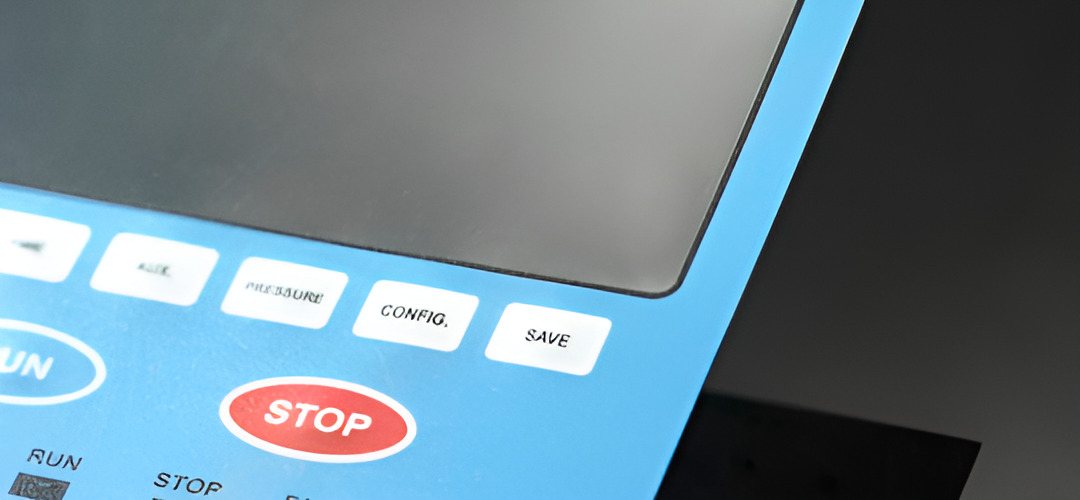
A membrane switch keypad is a user interface built by laminating a printed graphic overlay, screen-printed silver circuit layers on polyester film and a spacer layer into a single assembly. Because the finished stack typically stays around 1 mm thick, membrane switch keypads are used where mounting depth is limited: control cabinets, medical devices, weighing systems and industrial machinery. At our facility in İkitelli OSB, Tuşhan Elektronik manufactures flat and embossed, metal dome and LED backlit membrane switch keypads to customer drawings.
What Is a Membrane Switch and How Does It Work?
A membrane switch is a normally open contact device. A spacer layer, perforated only at the key locations, separates the upper and lower circuit layers. When the operator presses a key, the upper circuit film deflects through the spacer opening and touches the matching conductive pad on the lower layer, closing the circuit. When pressure is released, the elastic recovery of the polyester film returns the upper layer to its original position and the contact opens.
Conductive traces are screen printed on PET film using silver-filled ink. A carbon layer is printed over the contact pads to prevent silver migration and oxidation, which gives a durable contact with low and stable contact resistance. The circuit exits the panel as a tail formed from the same film and plugs directly into a ZIF connector, so no separate wire harness or solder joint is required.
Membrane Switch Keypad Layer Construction
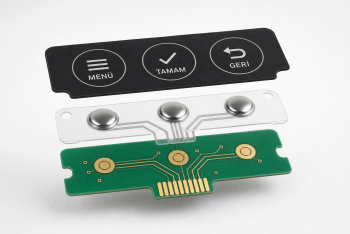
A typical membrane switch consists of six layers, with an overall thickness of 0.9-1.4 mm including the mounting adhesive. Layer count increases when LEDs, metal domes or shielding are required.
- Graphic overlay: PET or PC film printed on the second surface, so colours and legends are protected from abrasion in service.
- Overlay adhesive: Double-sided acrylic film bonding the overlay to the upper circuit, cut away at key and LED windows.
- Upper circuit layer: PET film with silver and carbon printing; forms the moving contact.
- Spacer layer: Double-sided adhesive film with openings at each key and venting channels routed to the edge.
- Lower circuit layer: Carries the fixed contact pads, traces and the ZIF tail.
- Rear mounting adhesive: High performance acrylic tape that fixes the panel to a sheet metal or plastic enclosure.
Metal dome versus poly dome
Tactile feedback is achieved in two ways. A stainless steel metal dome provides a crisp click and a life of 1-5 million cycles, which suits machine controls and frequently operated function keys. A poly dome, formed by embossing the polyester circuit film, gives a softer response and operates in the 100,000-500,000 cycle range, making it suitable for large key areas and cost-sensitive designs.
Membrane Switch Keypad Types
Flat membrane switch
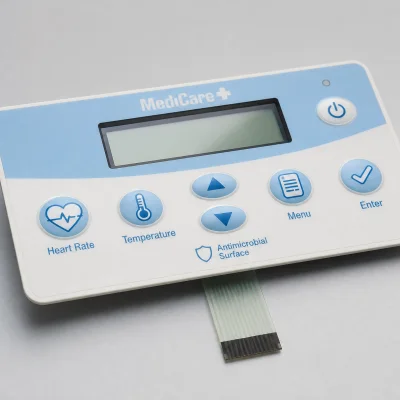
The key areas are level with the surrounding surface. The panel is easy to clean and does not trap liquids or dust, so it is common on food processing, medical and laboratory equipment. Metal domes can be added underneath when tactile feedback is still required.
Embossed membrane switch
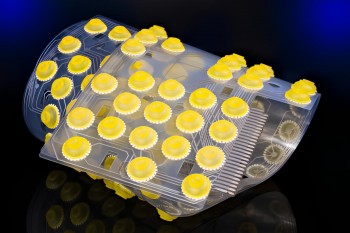
Key areas are raised by hot forming, so the operator can locate a key by touch alone. Embossing is produced either as a rim around the key or as a pillow that raises the whole key surface. This is an advantage where operators wear gloves.
Metal dome membrane switch
Four-leg or round stainless steel domes are positioned on a dome retainer film. Actuation force is typically in the 150-500 gf range and is set by the dome selection. The distinct click reduces accidental actuation in applications where operator error is critical.
LED and backlit panels
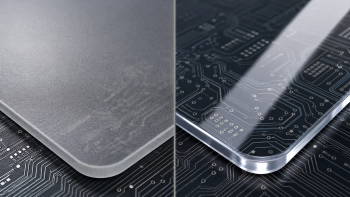
LEDs mounted on the circuit layer illuminate key legends or status indicators, with a typical LED life of 50,000-100,000 hours. Where uniform illumination is required, a light guide layer distributes brightness evenly across the key area, and translucent ink in the graphic layer lets light escape only through the intended legend.
Touch panels and embossed graphic panels
Where mechanical keys are not wanted, a touch panel provides a completely flat interface working together with a display. Where only enclosure decoration and legends are needed, an embossed graphic panel is produced without any circuit layer.